
Marketing Platform Modernization
Scaling to 20M+ emails per month with 80% lower operational cost through metadata-driven architecture.
Executive Summary
Modernized a fragmented, development-dependent email marketing platform into a scalable, metadata-driven system capable of supporting rapid business growth. Introduced a configurable architecture, reusable rendering framework, and standardized templates that transformed customer onboarding and campaign activation from a multi-week, engineering-heavy effort into a repeatable operational process completed in minutes. The platform scaled to support 1,500+ customers, 16 million end consumers, and 20 million emails per month, while reducing operational costs by 80%, accelerating product launch velocity, and establishing the foundation for future feature expansion and agentic AI-driven marketing workflows.
1500+
Customers Supported
16M
End Consumers Reached
20M/month
80%
Emails Delivered
Operational Cost Reduction
Business Context and Challenge
The company’s flagship product was entering a phase of rapid growth, adding 20–30 new customers per month, 1–3 million additional end consumers monthly and driving additional email volume growth of 1-2 million emails a month. Email marketing was a core feature, powering white-labeled, co-branded, and data-driven emails on behalf of customers. A newer add-on product, also centered on email engagement, was gaining adoption and further increasing demand on the platform.
However, onboarding new customers and enabling their email programs required significant manual coordination across multiple teams and systems. Operational staff had to navigate fragmented workflows to configure branding, templates, and campaign logic, resulting in high operational overhead and slower time to launch. Campaign rollouts for the add-on product were frequently delayed, and customer customization requests or product-driven enhancements often required bespoke development, limiting agility and responsiveness.
Because email engagement was a primary driver of active usage and recurring revenue, these constraints posed a direct risk to growth. The existing platform and operating model were not designed to scale at the pace the business required, making it clear that a more scalable, flexible, and operationally efficient marketing foundation was needed to support the company’s next stage of expansion.
Approach and Solution
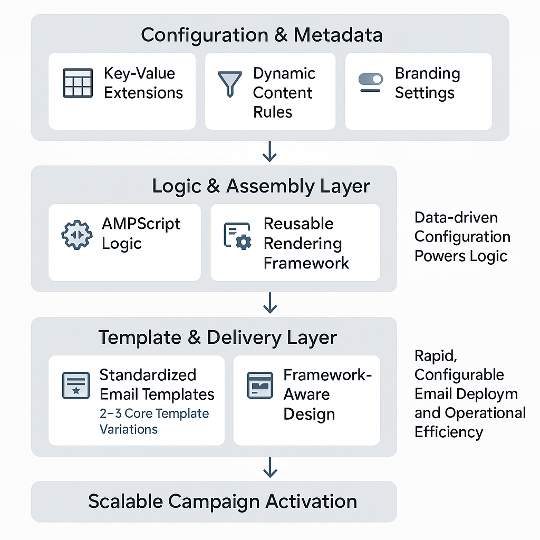
The core issue wasn’t just scale—it was rigidity. The email platform had been built in a way that required custom configuration and development effort for each new customer, campaign, or branding variation. To solve this, I led the design and implementation of a configurable architecture grounded in metadata. At the center was a structured configuration layer built using a set of related data extensions that functioned as a composite-key + value system. Every email template had a default configuration that worked out of the box, while also allowing customers to override specific content sections—such as branding, messaging, or product-specific elements—through simple metadata updates rather than code changes.
To operationalize this, I introduced a reusable AMPScript-based rendering framework that dynamically interpreted the configuration metadata and assembled each email section at send time. In parallel, I drove the consolidation of dozens of fragmented email templates into just 2–3 standardized, framework-compatible variations per product. This combination of configuration metadata, reusable rendering logic, and framework-aware templates eliminated the need for bespoke template development and made customization scalable without adding engineering overhead.
Finally, I paired the technical solution with operational enablement. I developed a clear activation guide and an Excel-based bulk configuration workflow that allowed operational teams to onboard new customers and launch campaigns by simply updating configuration data. What previously required cross-functional coordination and days—or even weeks—of effort could now be completed in minutes. This transformed email activation from a development-heavy process into a repeatable, operational task that scaled with the business.
Outcomes
The modernization transformed email marketing from an operational bottleneck into a scalable growth engine. The flagship product scaled to support over 1,500 customers (60% growth), reaching 16 million end consumers (80% growth) and delivering 20 million emails per month (100% growth) without requiring proportional increases in operational support. This ensured the platform could keep pace with accelerating customer acquisition and engagement.
The add-on product saw a step-function improvement in launch velocity, increasing from just 2–3 launches per month to tens of launches per month, eliminating a major source of customer friction. Operational efficiency improved significantly across both product lines, enabling rapid business expansion without corresponding growth in operational headcount. The shift to a configuration-driven model reduced operational costs by approximately 80%, while making campaign activation faster, more predictable, and repeatable.
Beyond immediate scale and efficiency gains, the new architecture became a strategic foundation for future innovation. The metadata-driven framework enabled faster rollout of new capabilities—including advanced features such as dynamic digital ad integrations—reducing feature development time by 50%. It also established the structural foundation needed to support future agentic AI-driven workflows, positioning the platform to continue evolving alongside the company’s product and growth strategy.